Why the burners are the last thing to touch
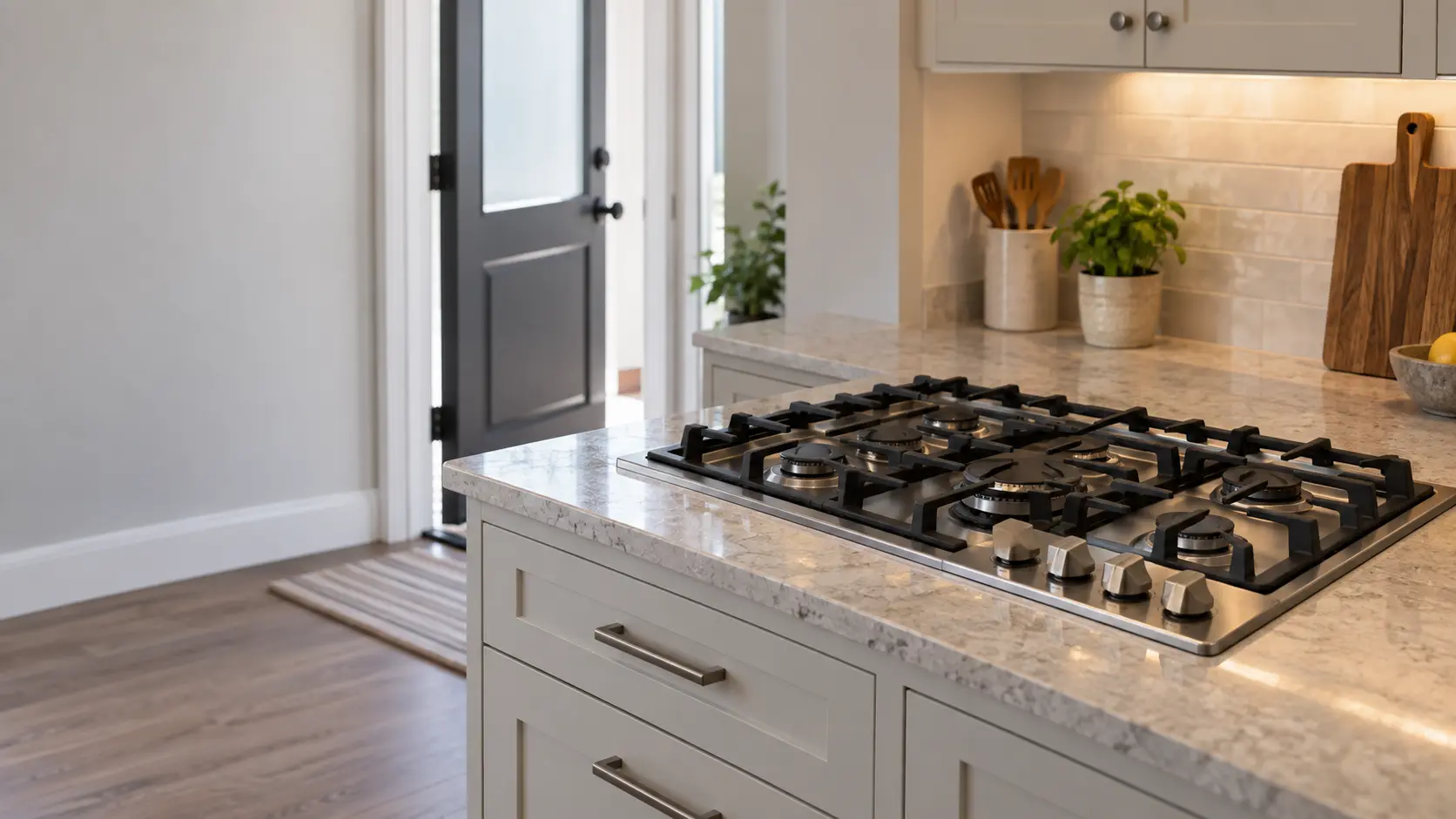
A cooktop sits at waist height in the middle of the counter, often in an island, with its knobs right under your hand. That is what makes a cooktop gas smell so tempting to deal with on the spot: one of those knobs might be a few degrees open. Gas utilities are unanimous that finding or stopping a leak is not a householder's task. The Public Service Commission of Wisconsin says it in one line: leave the area immediately and call the utility or 911 from a safe distance outdoors.
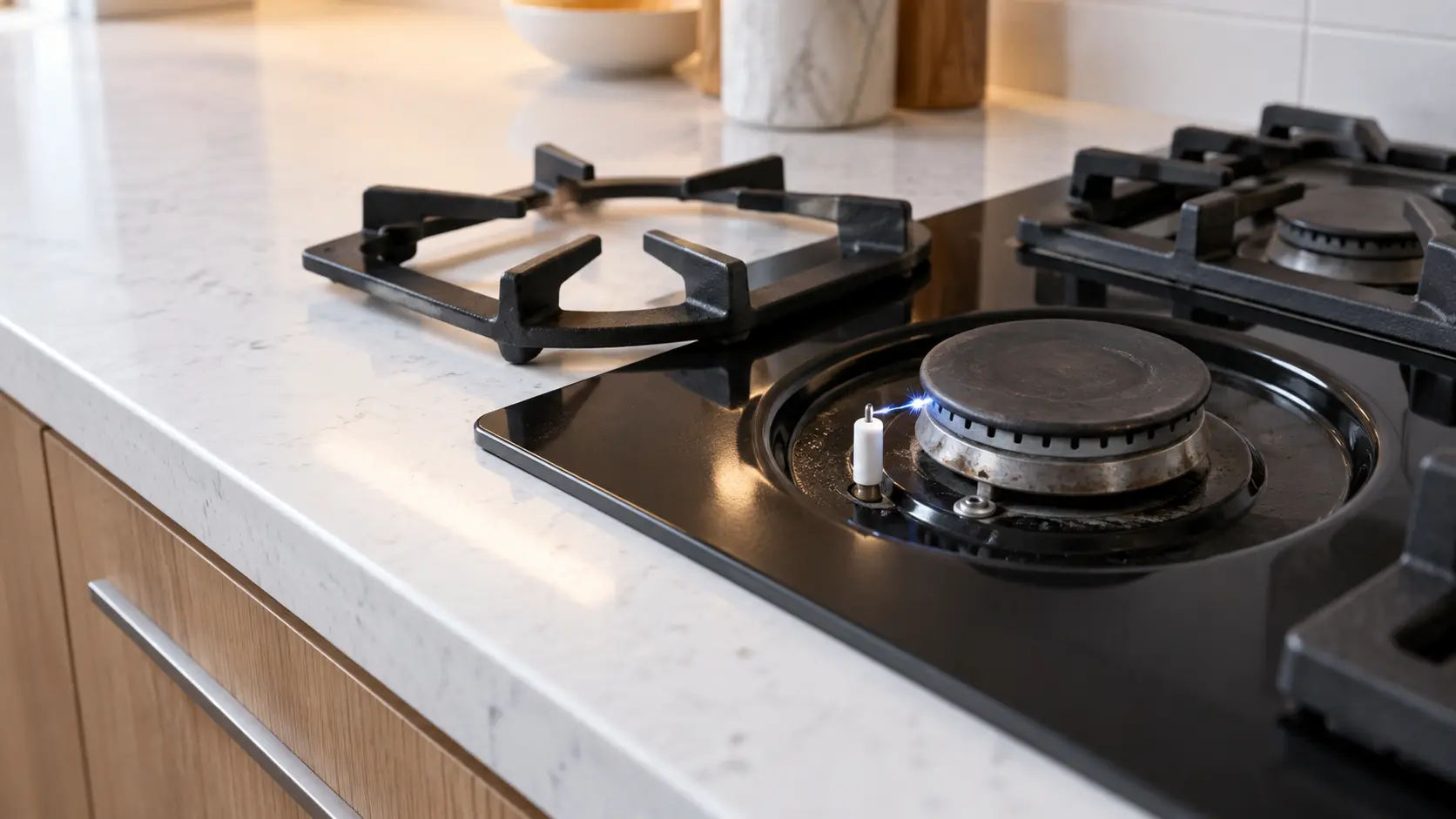
Turning a knob is not a neutral act on a modern gas cooktop. GE's manual for its Monogram downdraft gas cooktop explains that every igniter on the top clicks and sparks even when only one burner is being turned on, so reaching for any knob, even to turn it toward off, can fire a row of sparks into the gas you are smelling. The same reasoning covers anything else on the counter or the wall that switches current.
- Not a single knob, even the one you suspect is open.
- No touch key, light switch or under-cabinet light on the way out.
- No downdraft switch, whether the vent is raised or lowered.
- No match, lighter, flashlight or cigarette, and no starting a car in an attached garage.
- No phone call from inside the house, on a cell phone or a landline.
A knob turned but no flame under the grate
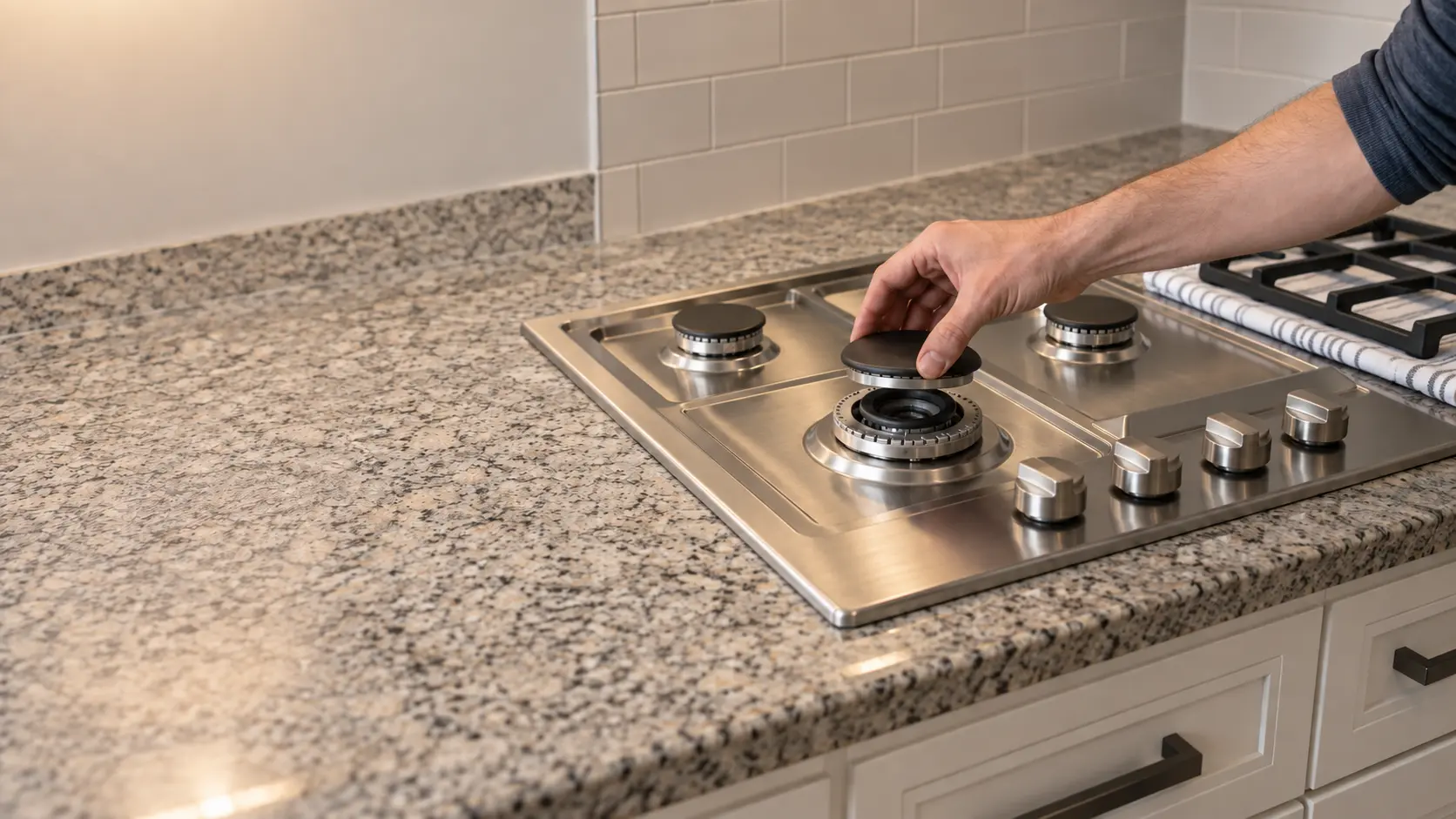
If you can see a knob resting at an on position with nothing burning, remember which one it was and tell the utility. Walking back to turn it puts your hands and face in the richest pocket of gas in the room, directly above the burner that has been releasing it.
A downdraft vent that is already running
On a cooktop with a pop-up or flush downdraft vent, the blower sits in the cabinet below and pulls air across the burners toward the duct. If it was already running when you noticed the smell, leave it running; switching it off at the counter or at the breaker is still a switch. If it was off, do not start it hoping to clear the air.
Source: Public Service Commission of Wisconsin — Natural Gas Consumer Safety — Leave immediately and call the utility or 911 from a safe distance outdoors; the odorant smells of rotten eggs, sulfur or garlic; a leak can hiss near a gas appliance; the utility maintains the meter and the line to it, the customer everything beyond; National Fuel — Smell Gas? Leave Fast — Natural gas is odorless and an odor is added; leave the area and move upwind if possible; do not light a match, start an engine, use a phone or light switches; GE Appliances — Monogram 36-inch downdraft gas cooktop ZGU660/ZGU661, Use and Care and Installation Guide (49-8715) — All igniters click and spark when one burner is turned on; what to do if you smell gas, including calling the fire department if the supplier cannot be reached; shut-off valve in an easily accessible location near the pipe stub, regulator and flexible connector; installer makes sure the owner knows how and where to shut off the gas; leak check with a liquid leak detector; never use an open flame to locate a leak
Where the gas runs on a built-in cooktop
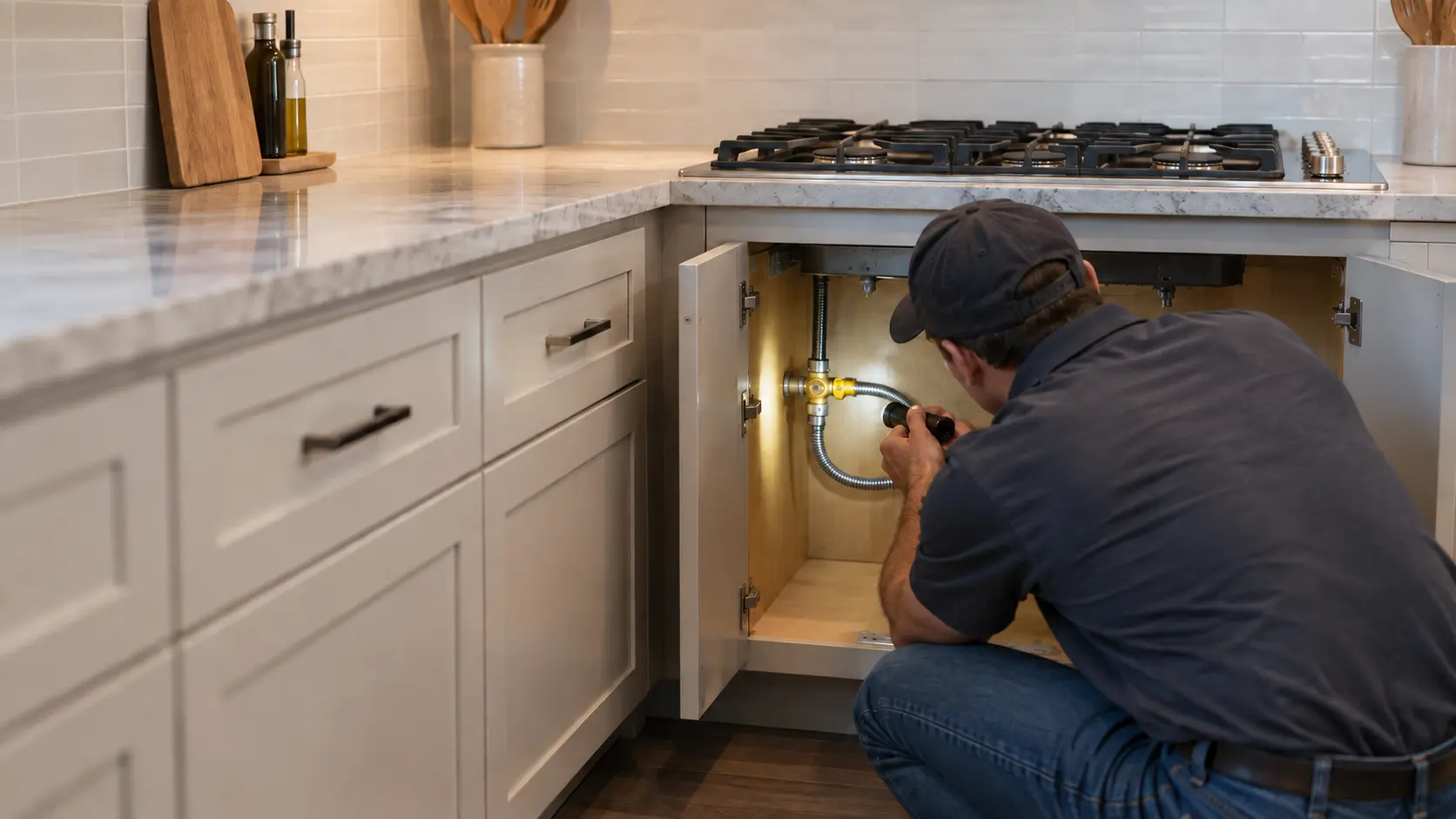
A freestanding appliance hides its gas connection behind itself; a built-in cooktop hides it underneath, inside the base cabinet. GE's installation pages for the downdraft cooktop trace the path: the house pipe enters the cabinet, a manual shut-off valve goes in an easily reached spot as close to the pipe stub as possible, a flexible metal connector or rigid pipe climbs to a pressure regulator, and the regulator feeds the burner manifold under the top.
Every joint along that route is a place gas can escape, and so is every burner valve behind a knob. The same cabinet usually holds things that do not mix well with a leak: aerosol cleaners, a trash bin, the outlet that powers the igniters. On a pro-style rangetop the layout is much the same, except that the supply often comes through the back wall into the base cabinet the rangetop rests on.
A smell strongest when the cabinet doors open
If the smell reached you as you opened the doors under the cooktop, close nothing and move nothing: step back and leave as you would for any other leak. Gas collected inside a closed cabinet can be concentrated enough to ignite, and that cabinet also holds the plug for the igniters. Tell the crew where the smell was strongest; it saves them time.
A hiss, or no hiss at all
The Wisconsin commission notes that a leak can make a hissing sound near a gas appliance. Silence proves nothing, though. A slow seep at a fitting under the counter makes no sound you would pick out over a refrigerator compressor or a running dishwasher.
Source: GE Appliances — Monogram 36-inch downdraft gas cooktop ZGU660/ZGU661, Use and Care and Installation Guide (49-8715) — All igniters click and spark when one burner is turned on; what to do if you smell gas, including calling the fire department if the supplier cannot be reached; shut-off valve in an easily accessible location near the pipe stub, regulator and flexible connector; installer makes sure the owner knows how and where to shut off the gas; leak check with a liquid leak detector; never use an open flame to locate a leak

Phoning it in from the sidewalk
Once everyone, pets included, is outside, move well away from the house, upwind if the weather allows, and call the gas utility's emergency line or 911. GE's cooktop manual adds a fallback worth remembering: if the gas supplier cannot be reached, call the fire department. No crew minds a trip that ends with a clean reading; confirming a kitchen is clear is part of their work.
Details that help the crew, every one of which can be given from the sidewalk:
- That the kitchen has a built-in gas cooktop or rangetop, and whether it sits in an island or along a wall.
- Whether the smell was strongest over the burners, low down at the cabinet doors, or somewhere else in the room.
- Whether a burner was in use, had just gone out, or had been clicking without catching.
- Whether the cooktop was recently installed, swapped, lifted out for a countertop job or converted from natural gas to propane.
- Whether anyone feels dizzy, nauseous or has a headache.
Source: National Fuel — Smell Gas? Leave Fast — Natural gas is odorless and an odor is added; leave the area and move upwind if possible; do not light a match, start an engine, use a phone or light switches; GE Appliances — Monogram 36-inch downdraft gas cooktop ZGU660/ZGU661, Use and Care and Installation Guide (49-8715) — All igniters click and spark when one burner is turned on; what to do if you smell gas, including calling the fire department if the supplier cannot be reached; shut-off valve in an easily accessible location near the pipe stub, regulator and flexible connector; installer makes sure the owner knows how and where to shut off the gas; leak check with a liquid leak detector; never use an open flame to locate a leak
When the printed manual gives a different order
Owners who keep the manual in a kitchen drawer sometimes find advice that reads a little differently. The same GE downdraft cooktop manual prints two lists: its safety pages say not to light any appliance, touch any electrical switch or use any phone in the building, and to call the gas supplier from a neighbor's phone; the installation pages begin their list with opening windows. Manuals of that age were written before cell phones and before utilities settled on today's plain message.
Where the two disagree, go with the gas utility's current instructions. National Fuel's version is to leave the area immediately, move upwind if possible and call its emergency line, avoiding sparks and sources of heat on the way. A window is worth opening only if it is directly on your path out and costs no time at all.
Should the valve under the counter be closed?
The GE manual's list of cooking precautions also says to turn off the gas to the cooktop if you smell gas. That valve lives inside the base cabinet, often behind a trash pull-out or a drawer box, so closing it means kneeling with your head in the space where gas collects. For a smell you notice right now, leave the valve as it is and let the utility decide. Knowing where it sits is for planned work such as a repair visit, and GE asks its installers to make sure owners know how and where to shut it off.
Source: National Fuel — Smell Gas? Leave Fast — Natural gas is odorless and an odor is added; leave the area and move upwind if possible; do not light a match, start an engine, use a phone or light switches; GE Appliances — Monogram 36-inch downdraft gas cooktop ZGU660/ZGU661, Use and Care and Installation Guide (49-8715) — All igniters click and spark when one burner is turned on; what to do if you smell gas, including calling the fire department if the supplier cannot be reached; shut-off valve in an easily accessible location near the pipe stub, regulator and flexible connector; installer makes sure the owner knows how and where to shut off the gas; leak check with a liquid leak detector; never use an open flame to locate a leak
Turning the burners back on, and who says when
The utility may close the valve at the cooktop, at the meter or both, and may hang a tag on it. Turning the supply back on is its call. The Wisconsin commission reminds customers that the utility maintains the meter and the line leading to it, while everything past that point is the customer's responsibility, so a leak inside a wall goes to a plumber or gas contractor and a leak at the cooktop goes to someone who works on cooktops.
Once the kitchen has been declared safe, our technician can look at the cooktop itself: whether each burner lights promptly and burns with a steady blue flame, whether the valves behind the knobs close fully, and whether the joints from the shutoff valve to the regulator pass a check with a liquid leak detector, as GE's instructions specify. That manual is blunt about the alternative: never use an open flame to locate a leak.
Source: Public Service Commission of Wisconsin — Natural Gas Consumer Safety — Leave immediately and call the utility or 911 from a safe distance outdoors; the odorant smells of rotten eggs, sulfur or garlic; a leak can hiss near a gas appliance; the utility maintains the meter and the line to it, the customer everything beyond; GE Appliances — Monogram 36-inch downdraft gas cooktop ZGU660/ZGU661, Use and Care and Installation Guide (49-8715) — All igniters click and spark when one burner is turned on; what to do if you smell gas, including calling the fire department if the supplier cannot be reached; shut-off valve in an easily accessible location near the pipe stub, regulator and flexible connector; installer makes sure the owner knows how and where to shut off the gas; leak check with a liquid leak detector; never use an open flame to locate a leak