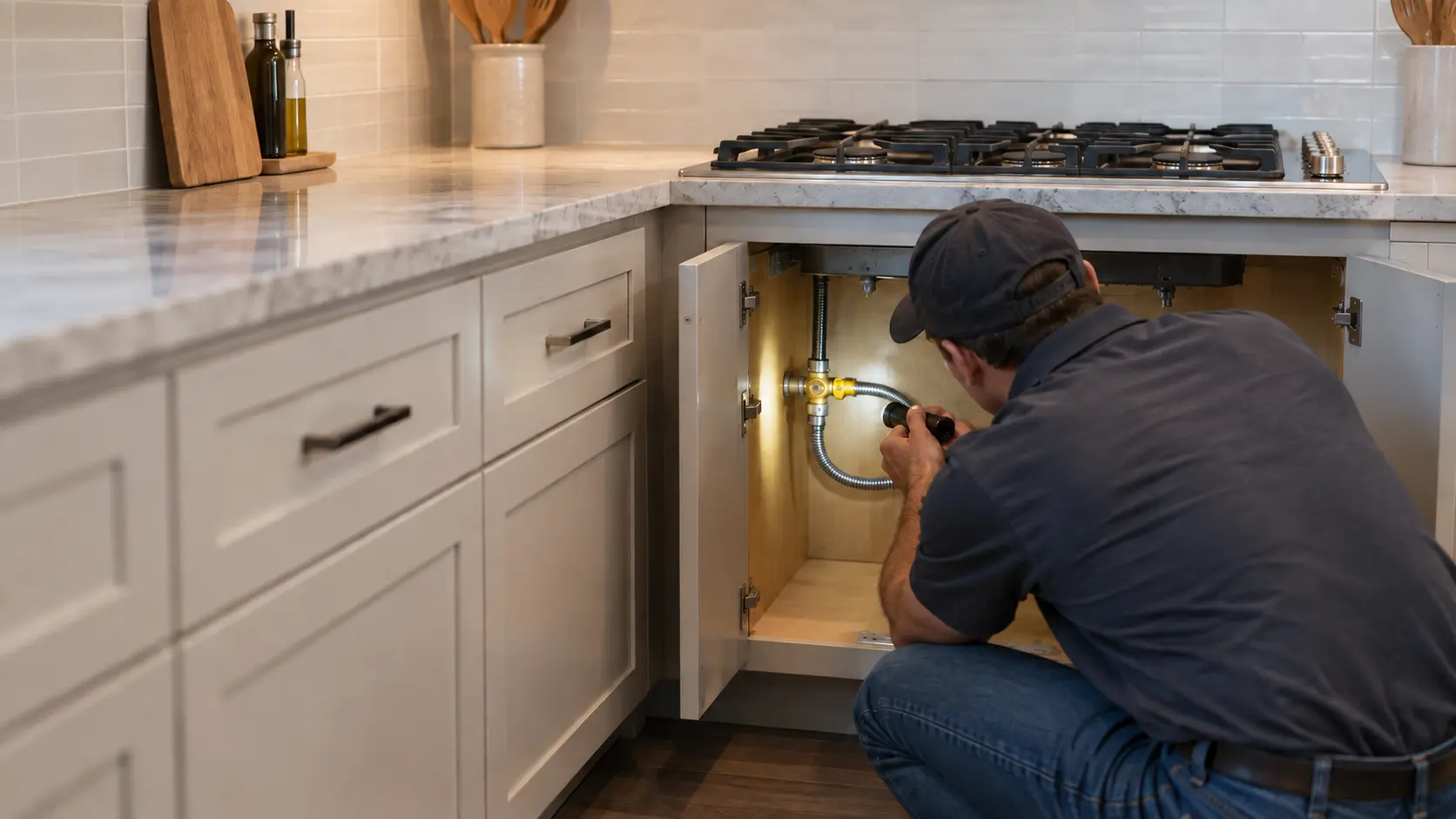
What you should find in the cabinet below
What the base cabinet holds depends on the kind of cooktop above it. Before anyone reaches in, it helps to know which parts are normal and which ones should make you close the doors and call. None of the checks in this guide involve loosening anything; they are about seeing what is there and labeling it while nothing is wrong.
Below a gas cooktop or rangetop
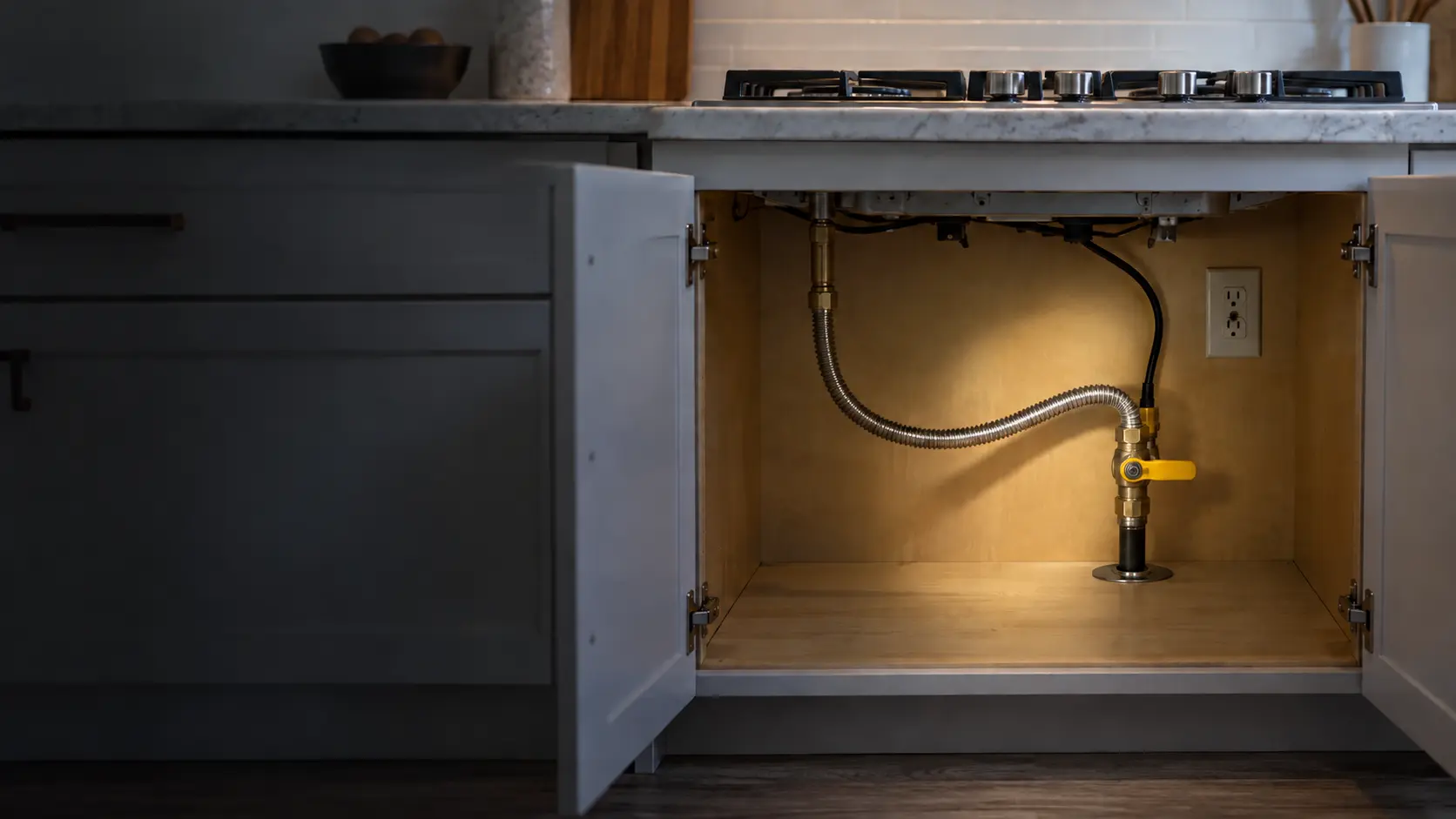
GE's installation instructions for a Monogram downdraft gas cooktop describe the standard set, from the wall inward:
- The gas pipe entering through the cabinet back or floor, ending in a manual shut-off valve.
- A flexible metal appliance connector, where local codes allow one, or rigid pipe.
- The pressure regulator supplied with the cooktop, fitted close to the cooktop's gas inlet.
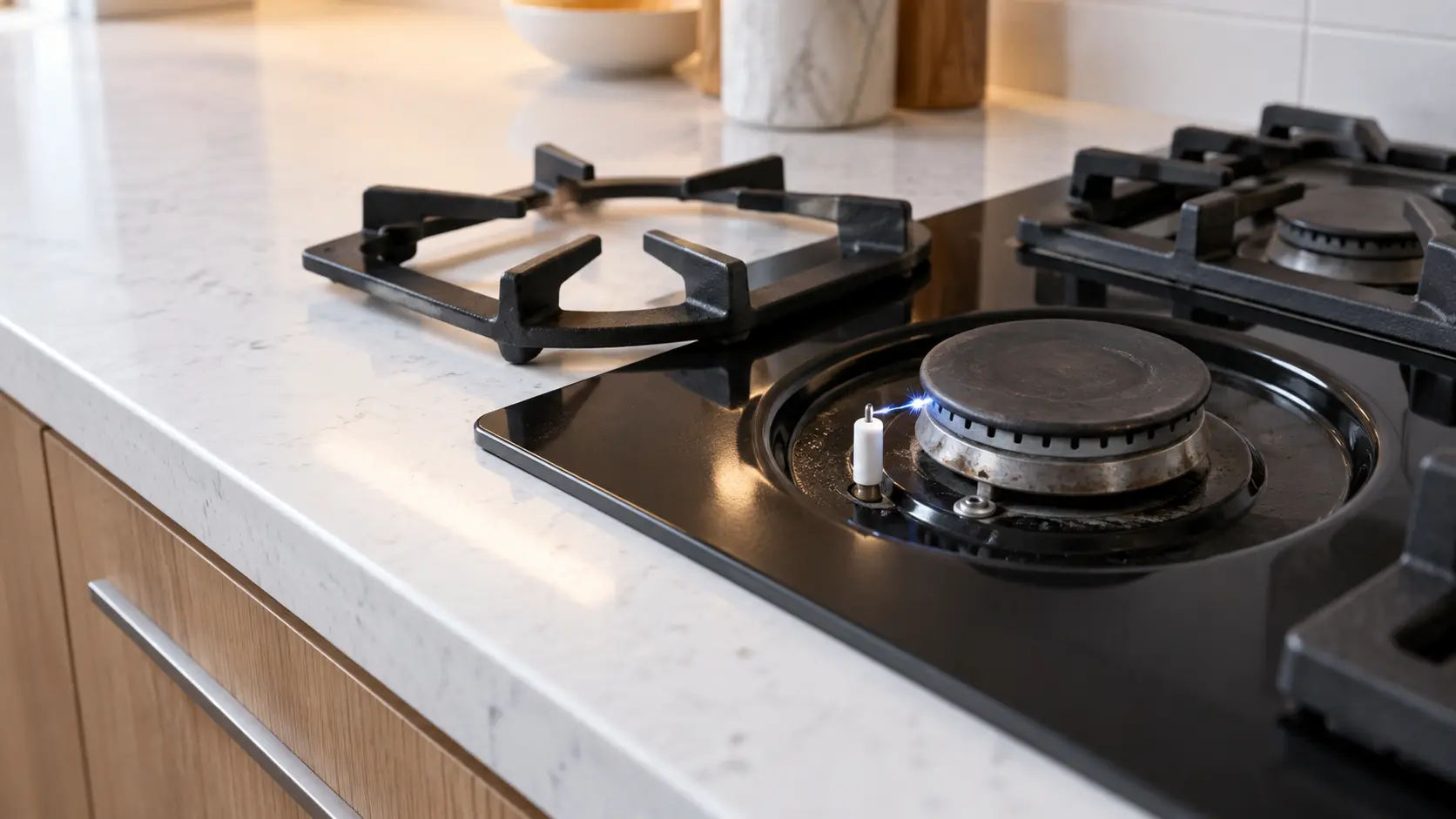
- A grounded 120-volt outlet for the cooktop's plug cord, which powers the igniters.
- On a downdraft model, the blower and the duct leaving the cabinet toward the outdoors.
Below a radiant or induction top
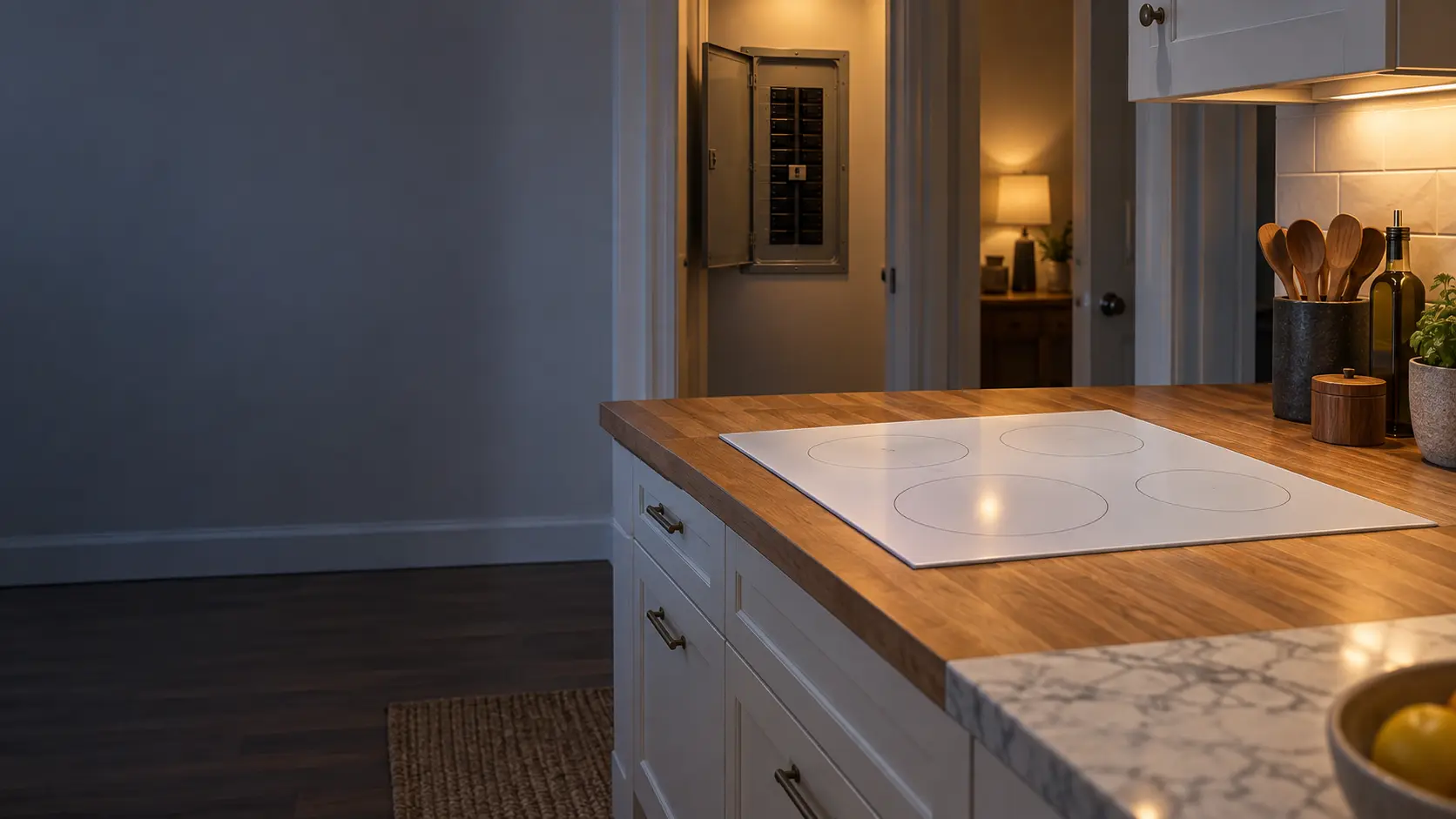
An electric or induction cooktop has no plug. A length of flexible armored conduit leaves the underside of the cooktop and ends at a junction box fixed to the cabinet back or the wall behind it, where the cooktop's leads are joined to the house wiring. On an induction top you may also see intake or exhaust openings for its cooling fan, which need to stay clear.
The cooktop junction box and its conduit
Dacor's instructions for its 30- and 36-inch induction cooktops give a representative set of rules. The supply is a 3-wire or 4-wire, single-phase, 208 or 240-volt circuit on a dedicated double-pole breaker of at least 40 amps for the 30-inch top and 45 amps for the 36-inch. The junction box sits at least 15 inches below the bottom of the countertop and within 10 inches of the right side of the cabinet, and a listed conduit connector is needed at each end of the cooktop's cable.
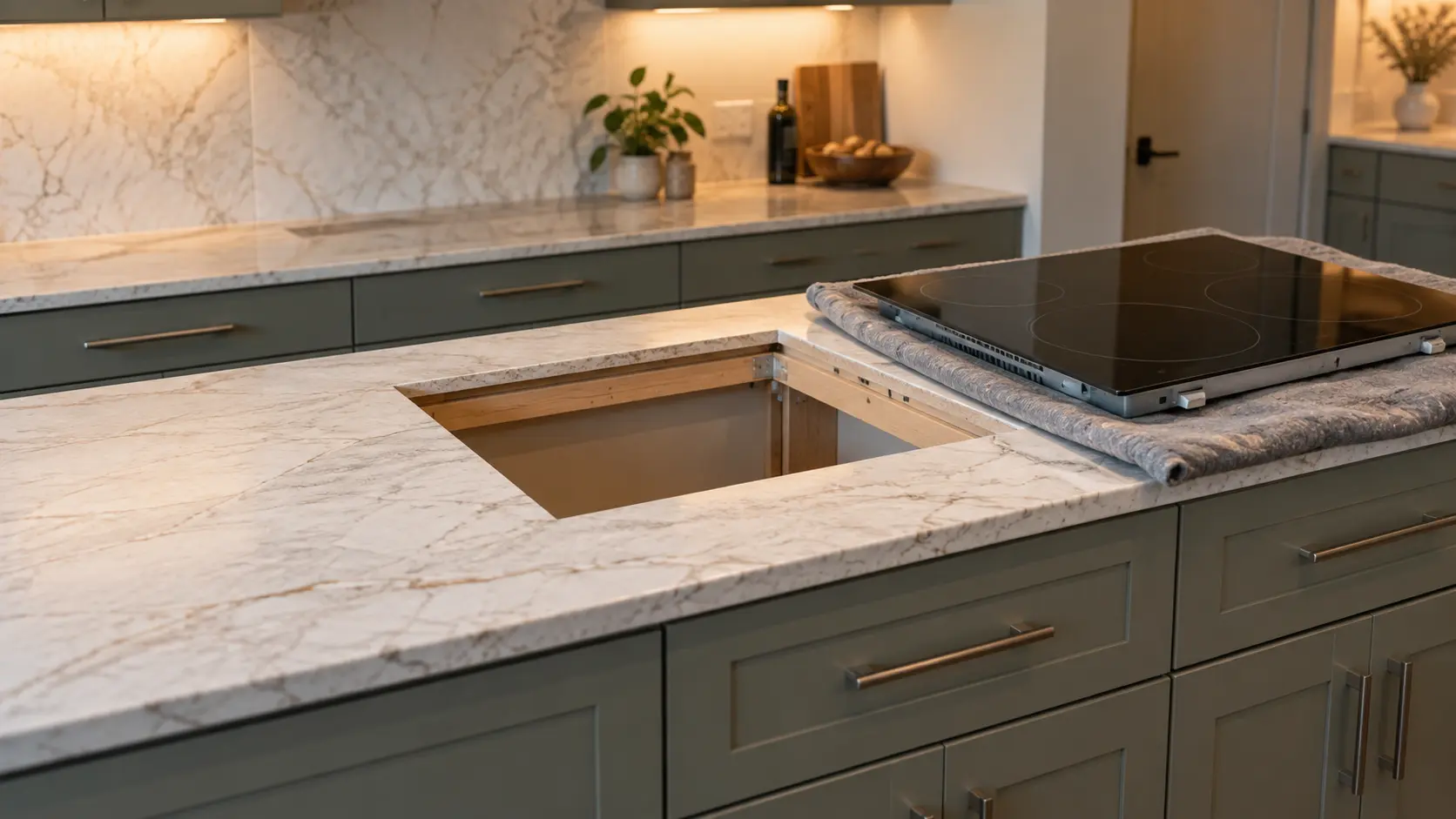
Two of Dacor's instructions matter long after installation. The conduit must not be cut; the length supplied is used whole. And the box must sit where the conduit has considerable slack, so the cooktop can be lifted out of the counter for servicing without disconnecting it first. A cooktop wired tight to a box right under the chassis is one that cannot be raised to replace a board or the glass.
Three conductors or four
Older homes often have a three-conductor cooktop circuit, with the appliance's frame grounded through the neutral; newer wiring uses four conductors with a separate ground. GE's induction manual shows both, and says a four-conductor connection is used where local codes do not permit grounding through the neutral. Which applies to your kitchen is the electrician's call, and it is a common reason a replacement cooktop cannot simply be connected the way the old one was.
Homes with aluminum branch wiring
Cooktop leads are copper. Both GE and Dacor warn that joining them directly to aluminum house wiring is dangerous, and require special connectors listed for joining copper to aluminum, used exactly as their maker describes. If your home was built with aluminum branch circuits, say so when booking.
Source: Dacor (Samsung) — Transitional 30- and 36-inch Induction Cooktop Installation Manual (DTI30P876BB, DTI36P876BB) — 3- or 4-wire 208/240-volt supply on a dedicated double-pole breaker of at least 40 amps (30-inch) or 45 amps (36-inch); junction box at least 15 inches below the countertop and within 10 inches of the right side of the cabinet; listed conduit connector at each end; do not cut the conduit; leave slack for servicing; special connectors for aluminum wiring; 5-inch clearance to a drawer below

The shutoff valve, connector and regulator
GE's gas cooktop instructions ask for a manual shut-off valve in an easily accessible location, as close to the pipe stub as possible, and ask the installer to be sure the owner knows how and where to shut off the gas to the cooktop. Behind a trash pull-out or a stack of pots, easily accessible can quietly stop being true, so it is worth keeping a clear path to it.
The same instructions describe a pressure regulator that stays in series with the cooktop whether it burns natural gas or propane, a flexible connector of 3 to 5 feet where codes allow one, and a leak check with a liquid leak detector at every joint once the gas is on. The cooktop leaves the factory set for natural gas; conversion to propane is done by a service technician or other qualified person. The Public Service Commission of Wisconsin recommends having a qualified person inspect appliance connectors, among other gas equipment, at least every other year.
Supply to a pro-style rangetop
A pro-style rangetop needs the same pieces as a gas cooktop, usually with more burners on one regulator and a larger gas demand. It sits on a base cabinet rather than in a cutout, so the valve and outlet are often reached through that cabinet's doors or from a drawer space removed for access. The same rule applies: know where the valve is, and leave the fittings to a gas technician.
Source: GE Appliances — Monogram 36-inch downdraft gas cooktop ZGU660/ZGU661, Use and Care and Installation Guide (49-8715) — Manual shut-off valve in an easily accessible location near the pipe stub; owner told how and where to shut off the gas; regulator in series for natural gas and LP; 3- to 5-foot flexible connector where codes permit; leak check with a liquid leak detector; shipped set for natural gas, LP conversion by a qualified person; 120-volt grounded plug cord, no extension cord; Public Service Commission of Wisconsin — Natural Gas Consumer Safety — Have a qualified person inspect furnaces, vents, appliance connectors and chimneys at least every other year
A flashlight check for owners
With the cooktop off and cool, a flashlight and a few minutes are enough for a useful look. The aim is to spot trouble and to have answers ready for the booking, not to fix anything:
- The breaker for an electric or induction cooktop is labeled at the panel, and you know which one it is.
- The junction box has its cover on and no bare wire is visible anywhere.
- The gas shutoff valve can be reached without emptying the cabinet.
- The gas connector is not kinked, crushed by a drawer or rubbing on a sliding bin.
- The igniter cord of a gas cooktop is plugged fully into its outlet, with no extension cord.
- Nothing is stored against the conduit, the regulator or an induction top's air openings.
Using the cabinet without crowding the connections
The cabinet under a cooktop is prime storage, and most problems we find there come from how it is used rather than how it was built. Pull-out trash bins and drawer boxes that slide under the regulator or the conduit can wear through a connector or bend a fitting over years of daily use. Aerosol cleaners and solvents are better kept elsewhere, especially under a gas cooktop.
Dacor's instructions ask for at least 5 inches from the top of the countertop to the top of any drawer below its induction cooktop; for a gas or downdraft model the space needed is usually greater. If a drawer was added after the cooktop went in, check that it clears the chassis, the conduit and the gas connection through its whole travel.
Source: Dacor (Samsung) — Transitional 30- and 36-inch Induction Cooktop Installation Manual (DTI30P876BB, DTI36P876BB) — 3- or 4-wire 208/240-volt supply on a dedicated double-pole breaker of at least 40 amps (30-inch) or 45 amps (36-inch); junction box at least 15 inches below the countertop and within 10 inches of the right side of the cabinet; listed conduit connector at each end; do not cut the conduit; leave slack for servicing; special connectors for aluminum wiring; 5-inch clearance to a drawer below