
How a downdraft vent moves the air
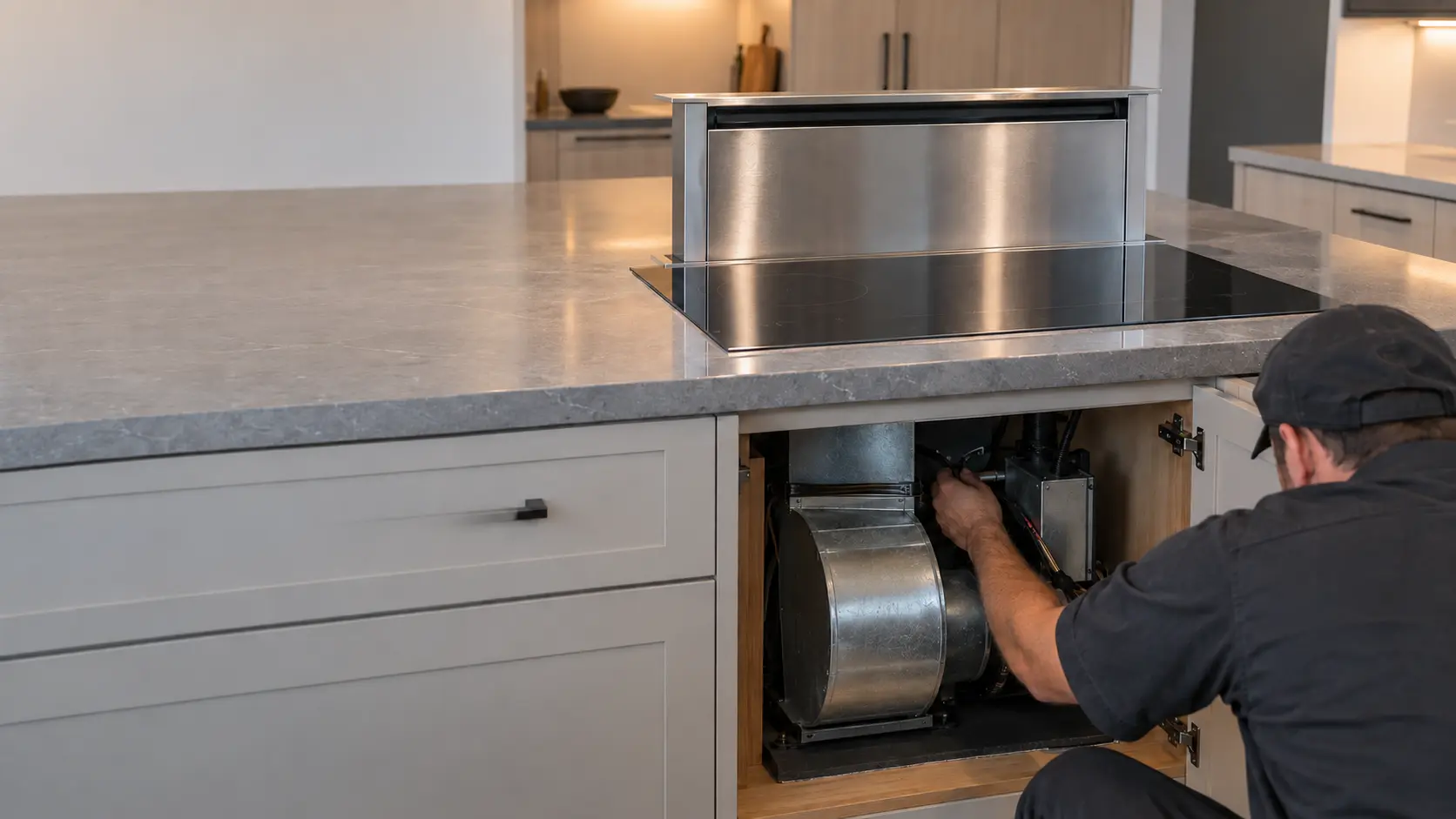
A downdraft vent sits either in the middle of the cooktop between the burners or elements, or along the back edge as a panel that rises when switched on. A blower in the cabinet below, or sometimes a remote blower outside, draws air across the cooking surface, through a grate and a grease filter, into a chamber and then down a duct that usually runs through the floor or the toe kick to the outside of the house.
Because the air turns sharply downward, a downdraft works best on low pans and short steam plumes. It struggles with tall stockpots, and grease that it does catch collects quickly in a small space. That is why the filter and the chamber need attention more often than the filters of an overhead extractor.
Center vents built into the cooktop
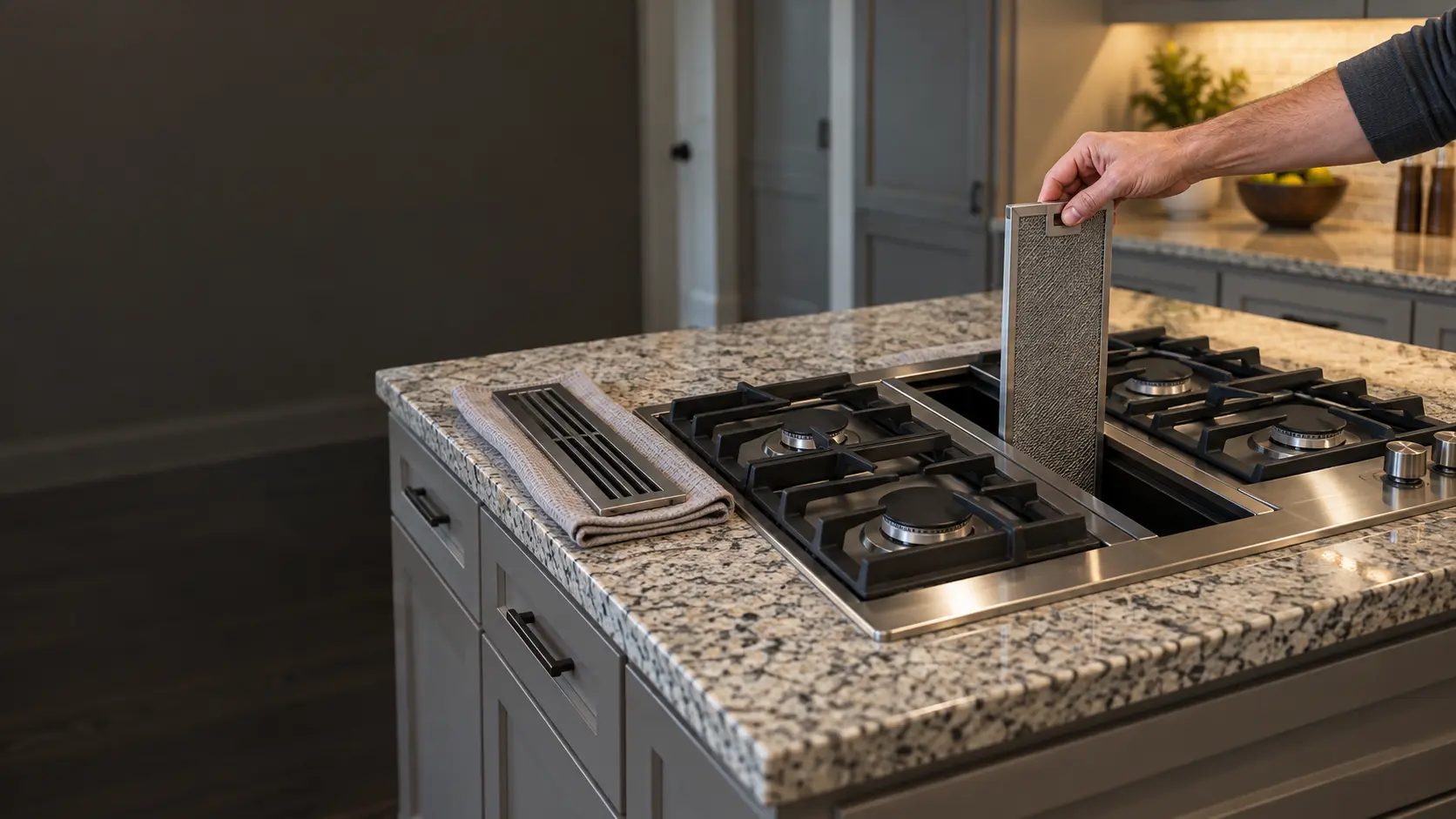
On a cooktop with a vent strip between the cooking zones, the grate lifts straight out of the top. On gas models, JennAir's instructions have you take the burner grates off first, then the vent grate, before lifting the filter out of the chamber. The chamber sits directly over the blower, so spills that get past the grate end up there.
Rear vents that rise from the counter
A telescoping vent behind the cooktop lifts on a motor and lowers into the counter when switched off. Its filter is usually reached from the top with the vent raised and the fan off, or from the front of the riser, as the manual for that model shows. Never force a stuck riser up or down by hand: the lift mechanism and its switch are in the cabinet below, and a jammed riser is a service call.
Source: JennAir — Cleaning the venting system (electric cooktop) — Remove the burner grates, then the vent grate, then lift the filter; wash in warm water and detergent or the dishwasher; a filter flat against the fan wall reduces ventilation
What to clean, and how often
Cleaning a downdraft vent is a short job once the rhythm is set. JennAir's guidance treats the filter as a permanent part to be cleaned whenever it is soiled and regularly enough to prevent a buildup of grease, and the chamber whenever there is a spill or a film of grease on its walls. In practice that works out to a simple rhythm in most kitchens:
- The grate: wipe after any cooking that spatters, and wash weekly in warm soapy water or the dishwasher with a mild detergent.
- The grease filter: wash every few weeks, sooner in a household that fries or sears often, and whenever it looks dull or feels tacky.
- The chamber: wipe out when a spill gets past the grate, and at least every few months even when it looks clean.
- The outside wall cap: glance at it from outside a couple of times a year to be sure the flap opens and is not blocked by nests or leaves.
Source: JennAir — Downdraft ventilation maintenance — Clean the permanent filter regularly and when soiled, in the sink or dishwasher; turn the ventilation off first; no abrasive pads on the grate; clean acidic spills when cool; place the filter at an angle, not flat on the fan wall; clean the chamber after spills or a film of grease

Washing the grease filter and the grate
Switch the downdraft fan off and let the cooktop cool before reaching near the vent. JennAir warns against scouring pads filled with soap, abrasive cleaners, steel wool and gritty cloths on the grate, which can damage its finish; soap, water and a soft cloth come first. Acidic spills such as tomato or vinegar should be wiped off as soon as the appliance is cool, since they can mark the surface.
Soak a heavily loaded filter in hot water with a degreasing dish detergent for a quarter of an hour before scrubbing it gently with a soft brush, working with the mesh rather than against it. Rinse and let it dry fully before it goes back, so water does not drip into the blower.
Putting the filter back at the right angle
This is the step most owners get wrong. JennAir and KitchenAid both specify that the filter sits at an angle in the chamber: its top rests against one side of the vent opening and its bottom against the opposite side at the base of the chamber. A filter laid flat against the fan wall reduces the vent's effectiveness, and a vent that was pulling well before cleaning and weakly after it is very often just a filter set in the wrong way.
Source: JennAir — Downdraft ventilation maintenance — Clean the permanent filter regularly and when soiled, in the sink or dishwasher; turn the ventilation off first; no abrasive pads on the grate; clean acidic spills when cool; place the filter at an angle, not flat on the fan wall; clean the chamber after spills or a film of grease; JennAir — Cleaning the venting system (electric cooktop) — Remove the burner grates, then the vent grate, then lift the filter; wash in warm water and detergent or the dishwasher; a filter flat against the fan wall reduces ventilation; KitchenAid — Downdraft ventilation maintenance — The filter can be cleaned in the sink or the dishwasher and must be placed at an angle across the vent chamber
The chamber, and where owner cleaning ends
With the filter out, the chamber is open to view. Wipe it with a cloth dampened in warm water and dish detergent, wrung out well so nothing drips into the fan housing below, then dry it. Lift out any food or paper that fell through the grate. If there is standing liquid in the chamber after a boil-over, blot it up and leave the fan off until the chamber is dry.
Beyond the chamber lie the blower wheel, its motor, the duct and, on rising models, the lift motor. Those are not owner territory. Grease on a blower wheel throws it out of balance and makes it noisy; a duct packed with grease is a fire risk. Both are reasons to book service rather than to reach in.
- A fan that keeps running after being switched off, or will not switch off at all.
- A rumble, scrape or whine from the cabinet below when the vent runs.
- Weak pull with a clean, correctly angled filter.
- Grease dripping from the chamber or appearing inside the cabinet.
Source: JennAir — Downdraft ventilation maintenance — Clean the permanent filter regularly and when soiled, in the sink or dishwasher; turn the ventilation off first; no abrasive pads on the grate; clean acidic spills when cool; place the filter at an angle, not flat on the fan wall; clean the chamber after spills or a film of grease
Why a clean vent matters more over gas burners
A gas cooktop adds combustion gases to the cooking smoke. The EPA lists gas stoves among indoor sources of nitrogen dioxide and recommends an exhaust fan vented to the outdoors over them. A downdraft that is ducted outside and kept clean does that job; one choked with grease moves far less air, so more of what the burners produce stays in the kitchen. Run the vent whenever gas burners are on, not only when something smokes.
Source: EPA — Nitrogen dioxide's impact on indoor air quality — Gas stoves are an indoor source of nitrogen dioxide; install and use an exhaust fan vented to the outdoors over them